Some destinations earn their significance across centuries rather than seasons. They tend to share certain qualities: a sense of depth that reveals itself slowly, a close, almost personal relationship with their surroundings, and a stillness that holds even when the world outside is moving fast. You feel it on arrival, and long after you’ve left. Cambodia, Mykonos, London. Each one extraordinary in its own right, each one best experienced through an extraordinary hotel.
The alarm goes at 4am, and it is worth every second of lost sleep. In the stillness before dawn, the soaring towers of Angkor Wat rise dark against a sky that has barely begun to pale. Then slowly, the light grows, sliding over the intricately carved sandstone exactly as its 12th-century architects intended it to, a millennium of dawns designed in stone.
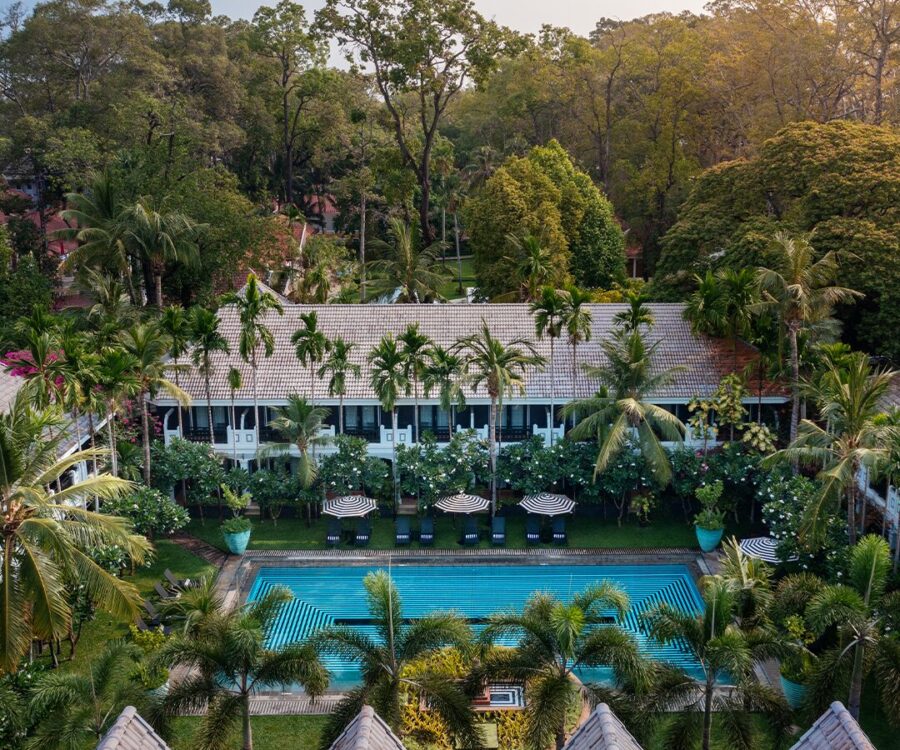
Fifteen minutes away, in the leafy Royal District of Siem Reap, Shinta Mani Angkor is a place to return to and exhale. Bill Bensley’s maximalist hand is felt throughout with bold, three-dimensional murals that evoke the robes of Khmer king Jayavarman VII, monochromatic geometric patterns underfoot, and custom-made furniture. Outside, the lush private garden holds a ten-metre pool and a deep soaking tub for bathing in the tropical air. Up on the rooftop terrace, a daybed invites mornings of lounging, a good book in hand, or a night spent sleeping out under a star-scattered sky.
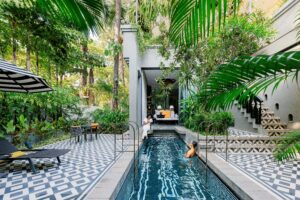
Each villa comes with a dedicated Bensley Butler, traditionally trained and endlessly resourceful, there when needed and invisible when not. The wider property offers its own reasons to linger: the Khmer Tonics Spa, two pools, and a restaurant that showcases the bold, layered flavours of modern Cambodian cuisine. Beyond the gates, Siem Reap rewards the curious with the Old Market, the river promenade, cooking classes, and the vibrant galleries and boutiques of the artistic Kandal Village waiting to be explored.
Liberally dotted with ancient monuments and crumbling ruins, Greece has a way of making history feel immediate. Mykonos is no different. The island has passed through the hands of the Byzantines, the Venetians and the Ottomans over the centuries. It only joined modern Greece in 1830, but its memory stretches back far further than that. Just seventeen miles across the water sits Delos, a UNESCO World Heritage Site that the ancient Greeks considered the birthplace of Apollo and Artemis, so sacred that no one was permitted to be born or die there. Mykonos grew up watching that horizon, and the reverence attached to it has shaped the island ever since.
At the top of Mykonos Town, where the views stretch all the way to Delos on the horizon, Myconian Deos takes its name from the ancient Greek word for awe. The setting earns it. The hotel’s 40 rooms and suites are finished in Cycladic tradition with Tinian marble, Cretan pottery and natural textures throughout, each with a private pool or hot tub and a terrace made for long, unhurried evenings. At Epico, Executive Chef Ilias Maslaris cooks with what the island produces – herbs from the hotel’s rooftop, local fish, and produce grown close by. For a spot of ‘R&R’, Sana’s treatments draw on locally harvested Aegean botanicals, with the spa’s wider philosophy honouring the Hippocratic philosophy of balance that has guided Greek wellbeing for centuries. Almiriki, the hotel’s private beach at Agrari, is among the most beautiful on the island – the water crystalline, the shoreline serene.
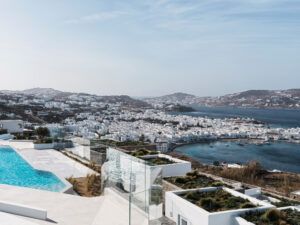
Mykonos rewards those who look beneath its surface, and Myconian Deos is the ideal base from which to do so. Certified guides lead visits to Delos itself – reachable by ferry in 30 minutes from the town harbour, or by private yacht combined with a day around the wild beaches of neighbouring Rhenia. Back on the island, ancient paths can be explored on horseback, the underwater world navigated by snorkel or scuba among octopuses, barracudas and ancient artefacts at sites like Paradise Reef. Private wine tastings and farm visits bring the island’s culinary heritage into focus, while the sea – sailed, swum or simply watched from the terrace as the water shifts through every shade – remains the constant.
Few cities wear their history as confidently as London. Before there was London, there was Londinium, a Roman settlement founded on the banks of the Thames nearly two thousand years ago. The city has been built, destroyed and rebuilt on that same ground ever since, each era leaving its mark on the one that follows.
To walk through its bustling centre is to thread through time without quite realising it. Close to St Paul’s Cathedral, a temple to the god Mithras has survived beneath the financial district since the 3rd century. The streets above still follow the Roman lines. Walk west and the centuries shift: the medieval lanes of Covent Garden, once the convent garden of Westminster Abbey, leading to the Strand, and then the deliberate curve of Regent Street, John Nash’s great reinvention of the West End in the 1820s, where Hotel Café Royal has stood since 1865.
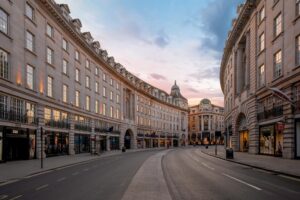
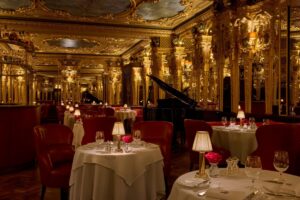
In the century and a half since, the building absorbed more of London’s cultural life than most institutions twice its age. Oscar Wilde held court in the gilded Grill Room, one of the great Victorian interiors. Winston Churchill and Diana, Princess of Wales, dined here. A 2012 transformation by David Chipperfield brought the building into a new era as one of the capital’s finest hotels. The 159 rooms and suites, finished in Carrara marble, fumed English oak and natural stone, range from elegant rooftop rooms with views across the city to the magnificent three-bedroom Dome Penthouse that crowns the Grade II listed building.
London rewards those who venture beyond the hotel’s considerable pleasures. East along the river, the Tower of London has stood for nearly a thousand years. West, the Royal Botanic Gardens at Kew hold plants gathered over three centuries of exploration, still growing in the same ground. In between, a short walk from the hotel’s front door, lies the full breadth of the city – Bond Street and Savile Row for shopping, the Royal Academy and National Portrait Gallery for art, and the theatres of the West End for evenings that tend to end with a well-deserved nightcap at Green Bar.
Discover more extraordinary stays with The Set.