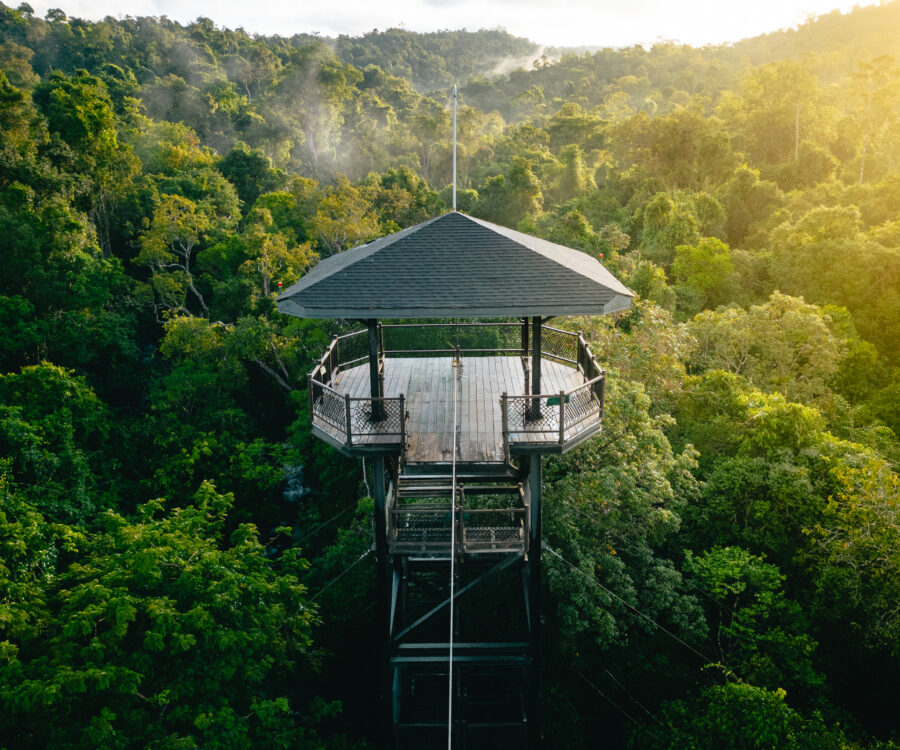
A zipline soars over the jungle canopy and rushing waterfalls deep within Cambodia’s Cardamom Rainforest. The aerial arrival to Shinta Mani Wild is theatrical – entirely as designer Bill Bensley intended. His instinct, in all things, runs toward the extraordinary.
Bensley not only designed this luxury encampment but also owns it, alongside business partner Sokoun Chanpreda. The 350-hectare plot they purchased saved an area the size of New York’s Central Park from mining, logging and poaching to create a remote stretch of protected rainforest. It was the beginning of a unique proposition, where wilderness and hospitality co-exist in support of one another – creating an experience that’s immersive, raw, playful, luxurious, and purpose-driven all at once.
It’s found within a spectacular location, at the point where the Cardamom, Kirirom and Bokor national parks converge. The resulting landscape is dramatic: mountains, grassy plains, dense jungle, bamboo forests, cascading waterfalls, and the Tmor Rung river running through it all, its steady current an unbroken backdrop to everything that happens here.
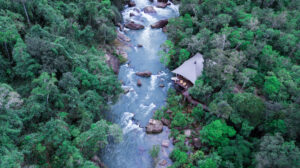
What often defies explanation is the emotional connection people develop with the landscape in such a short period of time. Something about waking up surrounded by rainforest, hearing gibbons in the canopy, crossing paths with ranger teams, or sitting silently beside the river shifts perspective in ways that are hard to anticipate. It feels less like visiting a hotel and more like temporarily becoming part of an ecosystem.
The fifteen tents are generously laid out along a one-mile stretch of the river, some positioned directly above the rapids, all raised from the ground so the forest’s natural habitat, and its wildlife, can continue undisturbed beneath. Outdoor rolltop baths, large decking areas accommodating al fresco sitting rooms, hand-painted murals, Asian antiques, and Cambodian art create a feeling of maximalism, without being too much.
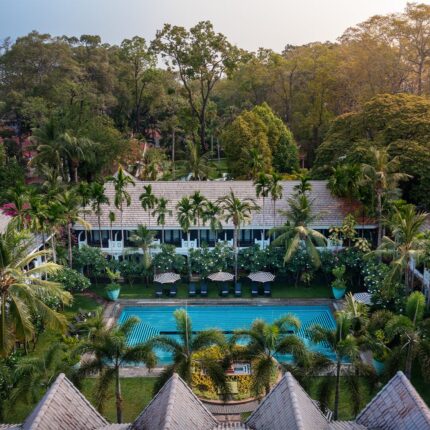
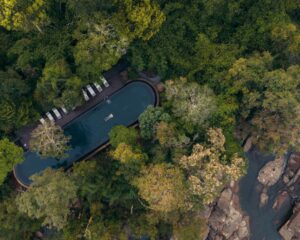
Each element of the camp has been considered through the conservation lens. The main gathering point – a tiered restaurant pavilion furnished in spring onion-hued rattan, a bar with the atmosphere of an explorer’s study. The spa, where guests are offered unlimited treatments, is tucked into the jungle. A 25-metre pool modelled on historic water cisterns has been designed to sit within the forest rather than impose upon it.
A Forest Worth Fighting For
The Cardamoms cover roughly 4.5 million hectares across southwest Cambodia and into Thailand, making them one of the largest remaining rainforest ecosystems in Southeast Asia – a biological corridor connecting fragmented habitats, a refuge for clouded leopards, Indochinese tigers, Asian elephants and sun bears, a watershed sustaining communities hundreds of kilometres downstream. It also came extraordinarily close to being lost entirely.
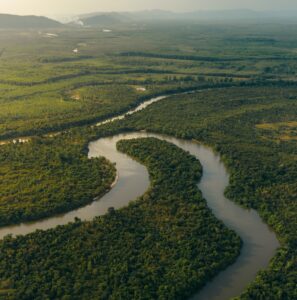
Illegal logging, wildlife trafficking, land encroachment – these are not past-tense problems. In the decades following Cambodia’s civil conflict, deforestation accelerated sharply across the country. Protected areas existed on maps more than on the ground. Shinta Mani Wild was built to generate employment and conservation funding that would give preservation a practical foundation. The mission is the reason the place exists.
That origin story drives decisions at every level – how waste is managed, how infrastructure is sited and built, what gets brought into camp and how. Each item carried into this stretch of forest carries an environmental footprint. The balance is not always straightforward. Sometimes the most sustainable decision is not the most attractive one. But the integrity of the ecosystem must remain the priority.
The Work That Keeps It Wild
All experiences are included and develop a deeper appreciation for slowness and observation. Explorations might include a three-hour hike through virgin landscape, or learning to drink water from pitcher plants and forage along the way. Each shows the value of allowing places that still feel genuinely wild to exist. A breakfast cruise down the Srey Ambel Estuary on an expedition pontoon, with stops for kayaking, or a sundowner tailgate on high ground, with a bonfire, cocktails served from a converted four-wheel drive, and a sky full of stars.
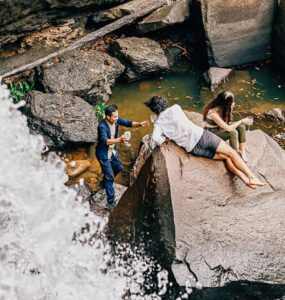
The camp’s conservation work offers the most affecting of all. At first light, before most guests have left their tents, ranger teams are already moving through the forest, working in partnership with the Wildlife Alliance – the organisation operating across the Cardamoms for more than two decades. Their work is methodical and physically demanding: patrolling difficult terrain, removing snares, monitoring wildlife, deterring the poaching and encroachment that continues to press against the forest’s edges.
Guests are invited to join the rangers on motorbike patrols, gaining a front-line understanding of what looking after this landscape actually requires. Walking beside the people doing this work, it becomes clear that conservation is resource-intensive and intentional.
The People Who Know It Best
Most of the camp’s staff – around 70 per cent – come from communities surrounding the Cardamoms, bringing knowledge of the forest that cannot be acquired from the outside – animal behaviour, seasonal patterns, sure-footedness crossing terrain known since childhood.

Conservation is complex. Among the forest’s most committed advocates are former poachers and loggers. Many individuals involved in illegal activities were responding to limited economic opportunity rather than disregard for the environment. Tourism alone cannot save ecosystems, but it can help generate funding, employment, visibility, and long-term incentives for sustainability when approached responsibly.
What the Forest Teaches
Spend enough time in the Cardamoms and the forest becomes a living system – wildlife, water, climate, human activity, all of it co-existing symbiotically. Those who live and work here speak of the profoundly grounding effect that spending time in intact rainforest environments can have. For many guests, it’s an insight into understanding ecosystems as interconnected systems that humans are part of.
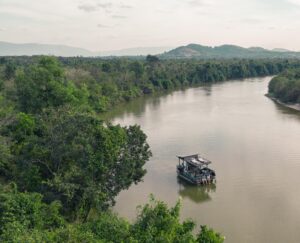
The fact that this ecosystem still exists at this scale is extraordinary. A stay here immerses guests within that environment. It offers proximity to a landscape still wild enough to transform perspective, alongside a deeper understanding of the people and partnerships working to ensure places like the Cardamoms continue to exist for generations to come.
Explore Shinta Mani Wild with The Set.